The Jazz Problem?

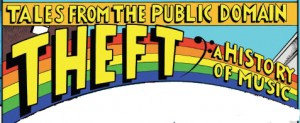
Another note in the research annals of our forthcoming comic on the history of musical borrowing.  For those who read about today’s wars over hip hop sampling and digital remix and think it a new battle fuelled by technological change, here’s an image that shows how old the fights are — even if one doesn’t trace them as far back as Plato.
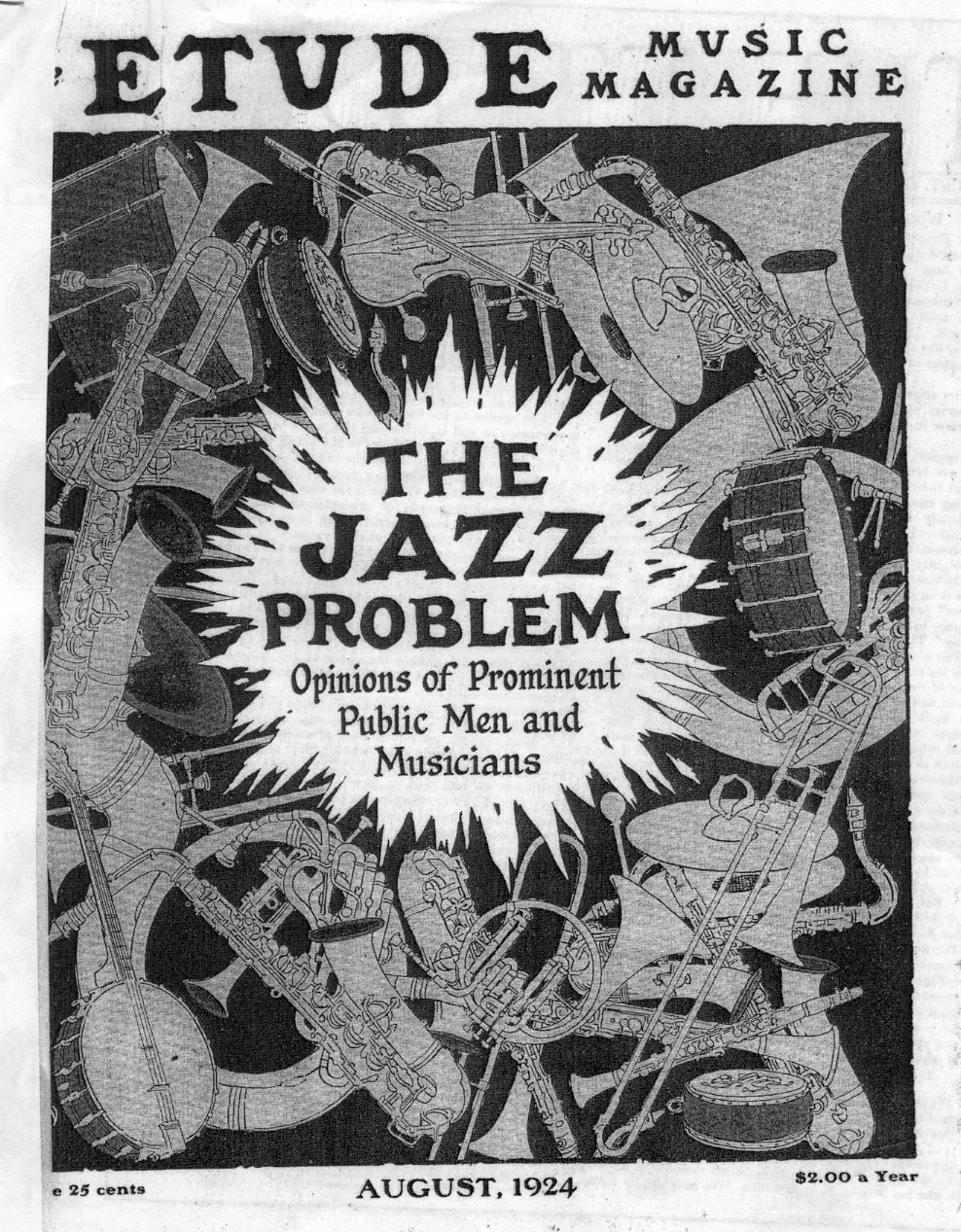
We got this from our brilliant colleague, the composer Professor Anthony Kelley. It is from Etude magazine and it contains a fascinating set of opinions of “prominent men and musicians” (and one female composer, Mrs. H.H.A. Beach) about “The Jazz Problem.”

What was The Jazz Problem?  Well, opinions differed.  Some saw it as a straightforward process of racial contamination of American music

“Jazz is to real music what the caricature is to the portrait…If jazz originated in the dance rhythms of the negro, it was at least interesting as the self-expression of a primitive race. When jazz was adopted by the “highly civilized” white race, it tended to degenerate it towards primitivity.”

That’s Frank Damrosch, Director of the Institute of Musical Art,  and a vocal proponent of musical racial purity. He had more to say on the subject — making it clear that part of the problem was the fact that jazz both distorted and borrowed in ways he found offensive.

“When a savage distorts his features and paints his face so as to produce startling effects, we smile at his childishness; but when a civilized man imitates him, not as a joke but in all seriousness, we turn away in disgust. Attempts have been made to “elevate” jazz by stealing phrases from the classic composers and vulgarizing them by the rhythms and devices used in jazz. This is not only an outrage on beautiful music, but also a confession of poverty, of inability to compose music of any value on the part of the jazz writers.”

The unselfconscious racism is remarkable.  For her part, Mrs. Beach was clear that the whole thing would lead to… er..  dancing

“[T]aken however in association with some of the modern dancing and the sentiment of the verses on which many of the “jazz” songs are founded, it would be difficult to find a combination more vulgar or debasing.”

John Philip Sousa, interestingly was much more sanguine

“There is no reason, with its exhilarating rhythm, its melodic ingenuities, why it should not become one of the accepted forms of composition.”

And many of the participants seem to agree that jazz was best in the hands of musicians who happened to be, well, white..  musicians like the aptly named Paul Whiteman.  But there were also moments when they acknowledged that this vital strand of American music had come from a culture that had been subjected to some forcible cultural remix itself.

“Good syncopation is legitimate and probably enjoyed to the limit by many people who are slow to admit the fact.  It has been evolved naturally from negro songs and dance tunes and is the characteristic American music if we have such a thing.“  [emphasis added]

Jazz did in fact  reach across racial lines — arousing hysteria in the process — as we say in our forthcoming comic.  But the reaction ran both ways.    Again and again as we have done our research, we have seen the borrowing question arise on at least two levels.  First, what practices of borrowing inside a particular tune are legitimate — philosophically, aesthetically, as a matter of religious doctrine, morally, and finally legally.  Second, what strands of musical tradition can be borrowed, remixed, and inserted into a different musical culture?  Which ones must be resisted as other, alien, debased, dangerous?  Culturally, the Anxiety of Influence runs deeper than we know.
Sunday, August 9th, 2009 comic, Music, Uncategorized

2 Comments to The Jazz Problem?

  1. Just to add a funny to this great post … In 1994 I was talking with a very well known Jazz vocalist and he said something that has really stuck in my mind.

    He told me that “Jazz is so powerful that it even brings the rhythm out of white men”.

    He was so right, we all originate from Africa and this prime-evil music is in our DNA and, as a result, it stirs deep in all of us.

    I think that all the other arguments over who ‘owns’ Jazz is just the bigots using something that we all love to split us up … We should all stand together in Jazz ;-)

  2. Colin Hall on October 5th, 2010
  3. [...] “Jazz Day,” April 30 enshrines a beautiful irony: music once considered cacophonous and “savage” is recognized at an international level as “…a force for positive social transformation [...]

  4. While We’re At It, Let’s Have Several National Jazz Days | Aesthetic, Not Anesthetic on May 2nd, 2012

Leave a comment

From the Blog

  • The Prosecution of Aaron: A Response to Orin Kerr

    Aaron Swartz committed suicide last week.  He was 26, a genius and my friend.  Not a really good friend, but someone I had worked with off and on for 11 years, liked a lot, had laughed with frequently, occasionally shaken my head over and deeply admired.

  • The Hargreaves Review

    An Intellectual Property System for the Internet Age

    James Boyle

    In November 2010, the Prime Minister commissioned a review of the Britain’s intellectual property laws and their effect on economic growth, quoting the founders of Google that “they could never have started their company in Britain” because of a lack of flexibility in British copyright..  Mr. Cameron wanted to see if we could have UK intellectual property laws “fit for the Internet age.”   Today the Review will be published. Its conclusion?  “Could it be true that laws designed more than three centuries ago with the express purpose of creating economic incentives for innovation by protecting creators’ rights are today obstructing innovation and economic growth?  The short answer is: yes.” Those words are from Professor Ian Hargreaves, head of the Review.   (Full disclosure: I was on the Review’s panel of expert advisors.)

  • Keith Aoki — A Remembrance Book

    A slideshow and downloadable book remembering Keith in words and pictures.  You can order a glossy, high quality copy of the book itself here from Createspace or here from Amazon.  We tried to make it as beautiful as something Keith would create.  We failed. But we came close; have a look at how striking it is… all because of Keith’s art.

  • Now THAT is how you teach a class

  • RIP, Keith Aoki

    Our friend, colleague, co-author and brilliant artist and scholar Keith Aoki died yesterday in his house in Sacramento.  He was 55 years old.

  • The Future of the Constitution?

    The Brookings Institution has organized a volume on “The Future of the Constitution” edited by Jeff Rosen and Benjamin Wittes and featuring articles by me, Larry Lessig, Jonathan Zittrain, Tim Wu and many others.  How will our constitutional tradition deal with the challenges posed by new technologies?  The topics range from possible personhood claims by artificial intelligences, to the future of free speech and the Net, to neuroscience and criminal punishment.  The essays are freely available online. Details after the jump.

  • Presumed Guilty

    My new FT column is up. Shakespeare, copyright, Scott Turow and a shadowy group of law professors..  What could be more fun? Ungated version after the jump. 

  • Waiting for ‘Waiting for Godot’

    What Could Have Been Entering the Public Domain on January 1, 2011?
    read more

  • Fantasy & Reality in Intellectual Property Policy

    My new column for the FT is up.  It deals with the incredible weakness of the data on which our intellectual property policy proceeds.   Ungated version after the jump

  • CBC Radio Interview on the History of Copyright

    Nora Young and the folk at CBC’s Spark have done it again, with a really nicely presented episode that includes a feature on copyright.  Nora interviews me about the history of copyright…  in 5 minutes.

  • EFF Pioneer Award Video

    Is here. I appear at 3:25 or so.

  • EFF Party in San Francisco!

    On November 8th, Cory Doctorow, John Perry Barlow, and numerous other digital luminaries will be gathering at the Minna Gallery in San Francisco for the EFF’s Pioneer Awards Party.  Cory is going to be the MC and — when not featured on XKCD blogging from a ballon in a red cape and goggles…

  • Net Neutrality Debate

    Great hour long radio show on net neutrality from NPR’s The State of Things.  Me, the inimitable Paul Jones of iBiblio, and Ryan Radia of the Competitive Enterprise Institute.  Frank Stasio is just a great interviewer.  Listen to it here

  • Op Art Comic in todays SF Chronicle

    We have a centerfold Op Art comic on “Copyright’s Futures”  in today’s San Francisco Chronicle.  The comic is

  • Why I Miss Justice Blackmun…

    This isn’t a post about intellectual property or the networked society, so if your interests only run that far, cease reading here.  In the late 80′s and early 90′s refugees were attempting to escape what was, in a decidedly non metaphorical sense, a hellish situation in Haiti..

  • Why We Need a Digital Civil Society

    Nitya Rajan interviewed me at Orgcon about why the legislative process malfunctions particularly badly on digital policy, and what the creation of civil society groups could do to fix that.  Video after the jump.

  • Who Steals the Gene from Off the Common

    My new Financial Times column on the creation of a science commons is now up.  For the ungated version, read on…

  • What if the Web Really Worked For Science?

    Here is the video of my speech in Vienna at the IRF symposium.  The title was What If the Web Really Worked for Science? Reimagining Data Policy and Intellectual Property.

  • Is Google Naive, Crafty or Stupid?

    I just started writing a column for the Huffington Post.  (I will still be writing for the FT.)  My first column is on the Google-Verizon announcement.  Not the “what” but the “why?”

  • Video of ORGCON keynote

    The Open Rights Group held its first big conference — ORGCON — in London last month and I was really honoured to give the keynote.  The Twitter cascade behind me, however,

  • Er… Bigfoot? Really?

    If one gets a lot of e-mail, one will eventually get very strange e-mail, but there is a frontier; an event horizon of bizarreness, that one doesn’t expect to be surpassed.  But life is richer than that.

  • Monopolists of the Genetic Code?

    Last week, Craig Venter created a media frenzy – and a frenzy of bioethical hand-wringing – when he announced the creation of the first “synthetic cell.” In reality,

  • Public Lectures in Lisbon and Florence

    Colleagues at Catolica University in Lisbon and the European University Institute in Florence have very kindly asked me to give lectures next week on “Cultural Agoraphobia”

  • NPR’s “On The Media” Interview: The Birthday of ©

    statute of anneBrooke Gladstone of On the Media interviews me about the birth, change and metastasis of copyright;

  • The Next Bad Thing?

    What if you could own the facts of the news?…..  Would that save the news industry?

  • Follow thepublicdomain on Twitter.

    Comic

    read

    Get my new book

    the book


    › Buy the book on Amazon
    › Download the book