Rappers Discuss Law Profs Discussing Rappers..

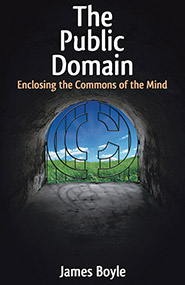
One of the delights of researching and writing The Public Domain was that I got to research so many fields, from jazz and soul and hip hop to synthetic biology, constitutional history and the story of the VCR.  It was a dilettantes’ delight.  I also got to interview fascinating people.  Two such folk were the rappers who, together, make up The Legendary KO — Damien Randle and Micah Nickerson — the duo who wrote George Bush Doesn’t Care About Black People as a protest about the handling of Hurricane Katrina by both the government and the media.

Now, I know what you are thinking — isn’t there a huge, almost unbridgeable gulf between you and them?  The answer is yes.  As Damien puts it in a recent blog post on Rappers I Know

Shortly thereafter, we got a call from Professor James Boyle, who teaches at the Duke School of Law. I was hesitant to take his call because i’m fan of UNC basketball, and hate Duke by default. I overcame my prejudices and obliged him.

Damien and I subsequently agreed that if we can overcome basic ingrained prejudices such as this, the problems of race, sex and class should be easy.  Anyway, the post features a Youtube video of my lecture on the history of Damien and Micah’s song.

This is the story of a song and of that song’s history. But it is also a story about property and race and art, about the way copyright law has shaped, encouraged, and prohibited music over the last hundred years, about the lines it draws, the boundaries it sets, and the art it forbids.

..On August 29th, 2005, a hurricane made landfall in Louisiana. The forecasters called it “Hurricane Katrina,” quickly shortened to “Katrina” as its story took over the news. The New Orleans levees failed. Soon the United States and then most of the world was watching pictures of a flooded New Orleans, seeing pleading citizens—mainly African-American—and a Keystone Cops response by the Federal Emergency Management Agency. The stories from New Orleans became more and more frightening. There were tales not only of natural disaster—drownings, elderly patients trapped in hospitals—but of a collapse of civilization: looting, murder and rape, stores being broken into with impunity, rescue helicopters fired upon, women and children sexually assaulted in the convention center where many of the refugees huddled. Later, it would turn out that many, perhaps most, of these reports were untrue, but one would not have guessed that from the news coverage.

..In Houston, Micah Nickerson and Damien Randle were volunteering to help New Orleans evacuees at the Astrodome and Houston Convention Center during the weekend of September 3. They, too, were incensed both by the slowness of the federal response to the disaster and by the portrayal of the evacuees in the media. But Mr. Nickerson and Mr. Randle were not just volunteers, they were also a hip-hop duo called “The Legendary K.O.” What better way to express their outrage than through their art?

The rest of the chapter is here.   The video has all the music. White Scottish law professor reading rap lyrics with careful enunciation got very high marks from the rapper audience.  It may be the new thing in hip hop culture and I promised to let Damien and Micah in on the ground floor.
YouTube Preview Image

http://twitter.com/thepublicdomain

Wednesday, August 12th, 2009 Uncategorized

1 Comment to Rappers Discuss Law Profs Discussing Rappers..

  1. its to much law in rap now but thats not how hiphop started
    it started from the heart an thats whats missing now

  2. philly on September 12th, 2009

Leave a comment

From the Blog

  • The Prosecution of Aaron: A Response to Orin Kerr

    Aaron Swartz committed suicide last week.  He was 26, a genius and my friend.  Not a really good friend, but someone I had worked with off and on for 11 years, liked a lot, had laughed with frequently, occasionally shaken my head over and deeply admired.

  • The Hargreaves Review

    An Intellectual Property System for the Internet Age

    James Boyle

    In November 2010, the Prime Minister commissioned a review of the Britain’s intellectual property laws and their effect on economic growth, quoting the founders of Google that “they could never have started their company in Britain” because of a lack of flexibility in British copyright..  Mr. Cameron wanted to see if we could have UK intellectual property laws “fit for the Internet age.”   Today the Review will be published. Its conclusion?  “Could it be true that laws designed more than three centuries ago with the express purpose of creating economic incentives for innovation by protecting creators’ rights are today obstructing innovation and economic growth?  The short answer is: yes.” Those words are from Professor Ian Hargreaves, head of the Review.   (Full disclosure: I was on the Review’s panel of expert advisors.)

  • Keith Aoki — A Remembrance Book

    A slideshow and downloadable book remembering Keith in words and pictures.  You can order a glossy, high quality copy of the book itself here from Createspace or here from Amazon.  We tried to make it as beautiful as something Keith would create.  We failed. But we came close; have a look at how striking it is… all because of Keith’s art.

  • Now THAT is how you teach a class

  • RIP, Keith Aoki

    Our friend, colleague, co-author and brilliant artist and scholar Keith Aoki died yesterday in his house in Sacramento.  He was 55 years old.

  • The Future of the Constitution?

    The Brookings Institution has organized a volume on “The Future of the Constitution” edited by Jeff Rosen and Benjamin Wittes and featuring articles by me, Larry Lessig, Jonathan Zittrain, Tim Wu and many others.  How will our constitutional tradition deal with the challenges posed by new technologies?  The topics range from possible personhood claims by artificial intelligences, to the future of free speech and the Net, to neuroscience and criminal punishment.  The essays are freely available online. Details after the jump.

  • Presumed Guilty

    My new FT column is up. Shakespeare, copyright, Scott Turow and a shadowy group of law professors..  What could be more fun? Ungated version after the jump. 

  • Waiting for ‘Waiting for Godot’

    What Could Have Been Entering the Public Domain on January 1, 2011?
    read more

  • Fantasy & Reality in Intellectual Property Policy

    My new column for the FT is up.  It deals with the incredible weakness of the data on which our intellectual property policy proceeds.   Ungated version after the jump

  • CBC Radio Interview on the History of Copyright

    Nora Young and the folk at CBC’s Spark have done it again, with a really nicely presented episode that includes a feature on copyright.  Nora interviews me about the history of copyright…  in 5 minutes.

  • EFF Pioneer Award Video

    Is here. I appear at 3:25 or so.

  • EFF Party in San Francisco!

    On November 8th, Cory Doctorow, John Perry Barlow, and numerous other digital luminaries will be gathering at the Minna Gallery in San Francisco for the EFF’s Pioneer Awards Party.  Cory is going to be the MC and — when not featured on XKCD blogging from a ballon in a red cape and goggles…

  • Net Neutrality Debate

    Great hour long radio show on net neutrality from NPR’s The State of Things.  Me, the inimitable Paul Jones of iBiblio, and Ryan Radia of the Competitive Enterprise Institute.  Frank Stasio is just a great interviewer.  Listen to it here

  • Op Art Comic in todays SF Chronicle

    We have a centerfold Op Art comic on “Copyright’s Futures”  in today’s San Francisco Chronicle.  The comic is

  • Why I Miss Justice Blackmun…

    This isn’t a post about intellectual property or the networked society, so if your interests only run that far, cease reading here.  In the late 80′s and early 90′s refugees were attempting to escape what was, in a decidedly non metaphorical sense, a hellish situation in Haiti..

  • Why We Need a Digital Civil Society

    Nitya Rajan interviewed me at Orgcon about why the legislative process malfunctions particularly badly on digital policy, and what the creation of civil society groups could do to fix that.  Video after the jump.

  • Who Steals the Gene from Off the Common

    My new Financial Times column on the creation of a science commons is now up.  For the ungated version, read on…

  • What if the Web Really Worked For Science?

    Here is the video of my speech in Vienna at the IRF symposium.  The title was What If the Web Really Worked for Science? Reimagining Data Policy and Intellectual Property.

  • Is Google Naive, Crafty or Stupid?

    I just started writing a column for the Huffington Post.  (I will still be writing for the FT.)  My first column is on the Google-Verizon announcement.  Not the “what” but the “why?”

  • Video of ORGCON keynote

    The Open Rights Group held its first big conference — ORGCON — in London last month and I was really honoured to give the keynote.  The Twitter cascade behind me, however,

  • Er… Bigfoot? Really?

    If one gets a lot of e-mail, one will eventually get very strange e-mail, but there is a frontier; an event horizon of bizarreness, that one doesn’t expect to be surpassed.  But life is richer than that.

  • Monopolists of the Genetic Code?

    Last week, Craig Venter created a media frenzy – and a frenzy of bioethical hand-wringing – when he announced the creation of the first “synthetic cell.” In reality,

  • Public Lectures in Lisbon and Florence

    Colleagues at Catolica University in Lisbon and the European University Institute in Florence have very kindly asked me to give lectures next week on “Cultural Agoraphobia”

  • NPR’s “On The Media” Interview: The Birthday of ©

    statute of anneBrooke Gladstone of On the Media interviews me about the birth, change and metastasis of copyright;

  • The Next Bad Thing?

    What if you could own the facts of the news?…..  Would that save the news industry?

  • Follow thepublicdomain on Twitter.

    Comic

    read

    Get my new book

    the book


    › Buy the book on Amazon
    › Download the book